Parklane Plowden Inquests Team Summer Article Roundup



Over the summer, our Inquests Team has delivered a series of insightful articles exploring some of the most significant developments and decisions in coronial law. Written by members of our specialist team, the series has covered a range of topics affecting practitioners, public bodies, healthcare professionals and families involved in the inquest process. From key decisions to practical guidance on emerging legal issues, these articles showcase the breadth of expertise within our team and provide valuable commentary on a rapidly evolving area of law. We are pleased to share a roundup of all the articles published to date.

Article 1: Dillon Carson
The judgment provides important guidance for practitioners considering challenges to coronial decisions. The Court rejected attempts to criticise the Coroner’s assessment of evidence by focusing on isolated points, describing the approach as an “island-hopping expedition in a sea of evidence”. Challenges on Wednesbury grounds must engage with the Coroner’s assessment as a whole, rather than selected pieces of evidence in isolation.
Article 2: Jade Ferguson
The case serves as a reminder that a person’s digital footprint may now be every bit as significant as traditional documentary evidence. As more of our lives move online, coroners will increasingly need to consider whether social media platforms and digital records contain evidence capable of explaining how someone came by their death.
Article 3: Bronia Hartley
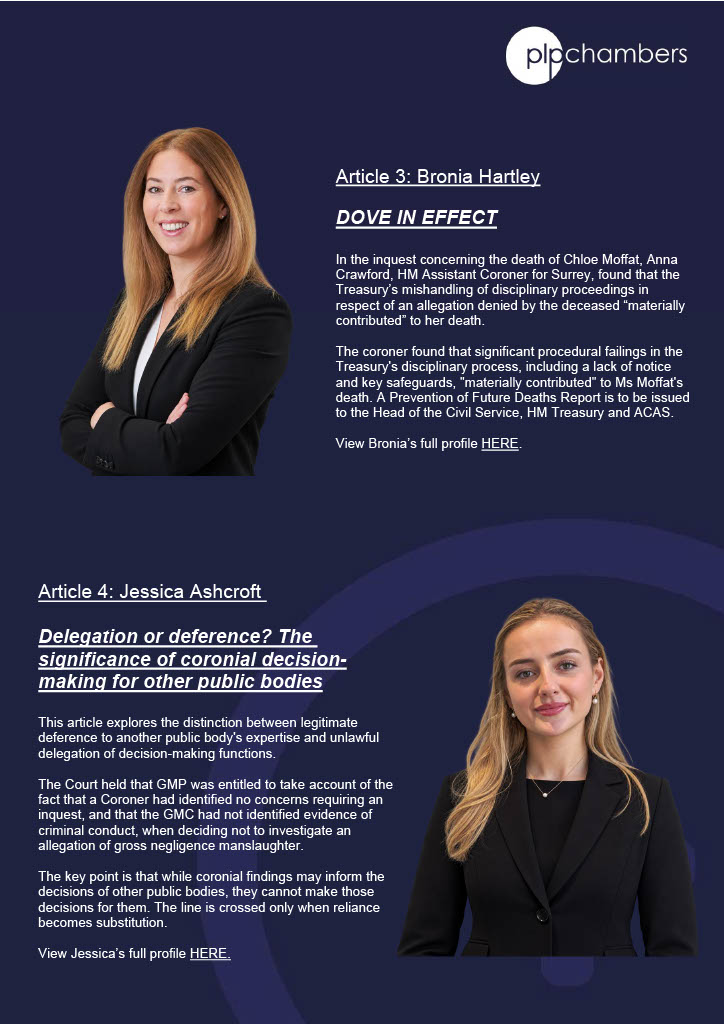
In the inquest concerning the death of Chloe Moffat, Anna Crawford, HM Assistant Coroner for Surrey, found that the Treasury’s mishandling of disciplinary proceedings in respect of an allegation denied by the deceased “materially contributed” to her death.
The coroner found that significant procedural failings in the Treasury’s disciplinary process, including a lack of notice and key safeguards, “materially contributed” to Ms Moffat’s death. A Prevention of Future Deaths Report is to be issued to the Head of the Civil Service, HM Treasury and ACAS.
Article 4: Jessica Ashcroft
Delegation or deference? The significance of coronial decision-making for other public bodies
This article explores the distinction between legitimate deference to another public body’s expertise and unlawful delegation of decision-making functions.
The Court held that GMP was entitled to take account of the fact that a Coroner had identified no concerns requiring an inquest, and that the GMC had not identified evidence of criminal conduct, when deciding not to investigate an allegation of gross negligence manslaughter.
The key point is that while coronial findings may inform the decisions of other public bodies, they cannot make those decisions for them. The line is crossed only when reliance becomes substitution.

Article 5: Georgia Banks
Complexities, Complications and Causation
The article explores the practical lessons arising from the judgment, including the importance of agreed lists of issues in cases involving complex medical causation and multiple expert witnesses.
It also examines the significant judicial review concerning the assessment of complex and conflicting medical evidence in an inquest following the death of a child from complications of sickle cell disease.
Article 6: Anna Datta
Does the word ‘poor’ denote negligence?
This article provides useful guidance on the boundaries of narrative conclusions in inquests.
The article considers the judgement, which serves as an important reminder that coroners may make evaluative factual findings, provided they do not attribute legal blame. As ever, the wording of narrative conclusions is critical, and the distinction between a factual finding and an impermissible expression of fault remains a fine but important one.
Head of Parklane Plowden Inquests Team: Leila Benyounes
Parklane Plowden inquests barristers have substantial experience of representing a broad range of interested persons at inquests and public inquiries. They have a proven track record of handling complex and high-profile cases concerning deaths arising in a variety of circumstances and settings. From deaths in custody, to medico-legal cases such as those arising in care homes and other institutions, the wealth of expertise available to bereaved families and corporate bodies is second to none.
Head of the Parklane Plowden Inquests team is Leila Benyounes, Leila is a specialist in Inquests and Inquiries, Clinical Negligence and Serious Injury, she represents both Claimants and Defendants which include private clients, public authorities and government departments.